
What Is a DPF Filter?
A DPF filter (Diesel Particulate Filter) is part of your van’s exhaust system. It was introduced to meet stricter emissions regulations and plays a crucial environmental role.
Its job is simple in principle:
It captures soot particles produced during diesel combustion and stores them in the filter to prevent harmful particulate matter from entering the atmosphere.
Over time, that soot builds up. If nothing were done, the filter would block completely – which is where regeneration comes in.
How Does a DPF Filter Work?
To keep the filter from clogging, your van performs a process called regeneration.
The DPF needs to reach extremely high temperatures (typically around 550–600°C) to burn off the soot and turn it into ash. This usually happens during:
- Longer journeys
- Steady driving speeds
- Motorway conditions
Why Motorway Driving Matters
From our experience, regeneration is far more reliable during motorway driving. That’s not just about speed – it’s about sustained engine load and consistent exhaust temperatures.
Short, stop-start journeys simply don’t generate enough heat for long enough. And if regeneration keeps getting interrupted, the soot keeps building.
The Real Problem: Urban Driving
Here’s where many businesses run into trouble.
If your van is used for:
- Trades
- Deliveries
- Courier work
- Local service jobs
That creates the perfect storm:
- Engine temperatures stay lower
- Journeys are too short
- Regeneration never completes

Common DPF Filter Problems
- Warning Lights – Your dashboard will often display a DPF warning light when the system detects a blockage.
- Limp Mode - The van may enter limp mode, reducing engine power to protect itself.
- Reduced Fuel Efficiency - A blocked filter restricts airflow, making the engine work harder and burn more fuel.
- Poor Performance - Acceleration and responsiveness can drop noticeably.
- MOT Failure Risk - If emissions are affected, your van could fail its MOT.
- More Serious Damage - One of the biggest risks we see is engine back pressure. This can lead to expensive issues - turbo failure being a common example linked to blocked DPF filters.
What Happens When the DPF Gets Blocked?
If the filter becomes too clogged, your van won’t be able to regenerate on its own.
At this point, you’ll need professional intervention.
Forced Regeneration
A garage can perform a forced regeneration, which involves:
- Connecting diagnostic equipment
- Electronically increasing exhaust temperatures
- Running the engine while stationary
This essentially forces the burn-off process that should happen during motorway driving.
However (and this is important) it doesn’t always work. If the filter is too heavily clogged, even a forced regeneration may fail.
Can You Clean a DPF Filter - And Does It Actually Work?
This is one of the most common questions we get from customers: “Can I clean my DPF filter instead of replacing it?”
The honest answer is: sometimes, but not always.
It really depends on how blocked the filter is and how early you catch the problem.
Let me break it down in plain English.
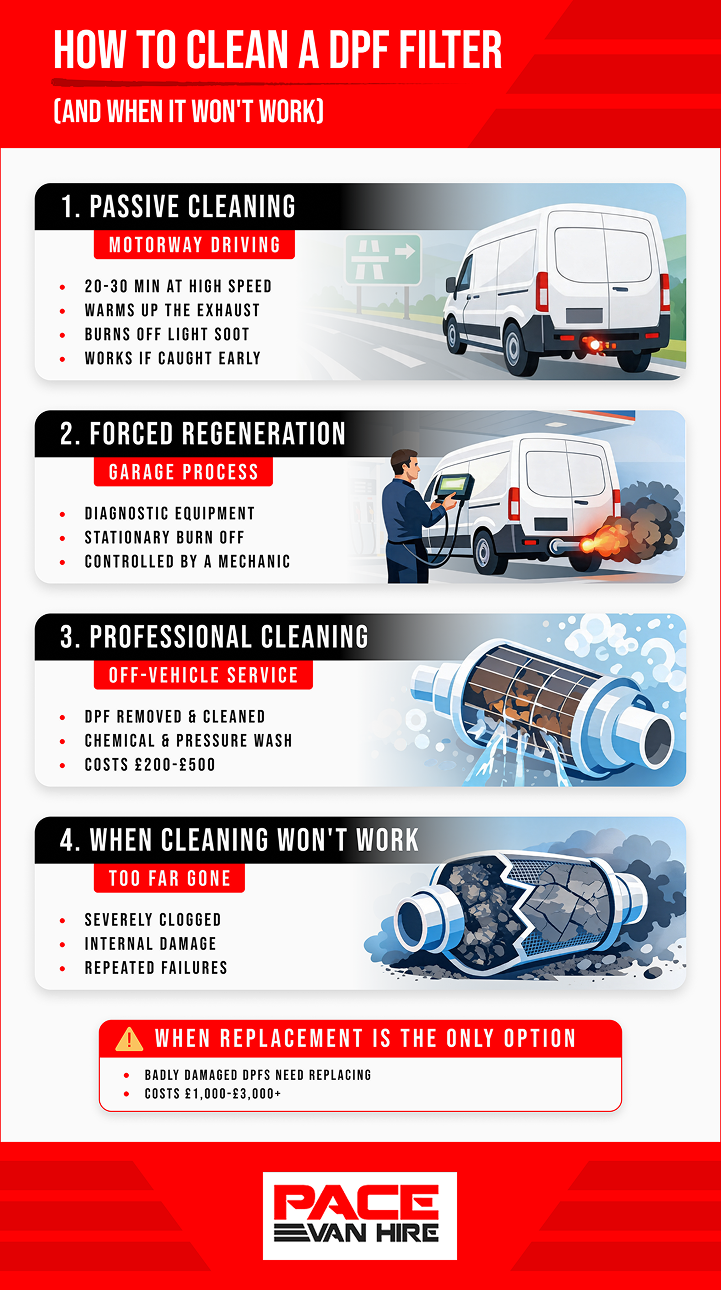
1. Passive Cleaning (The Ideal Scenario)
In the early stages of a blockage, the simplest way to clean a DPF filter is just by driving the van properly.
A good 20–30 minute run on a motorway or dual carriageway can allow the system to reach the temperatures needed (around 550–600°C) to burn off the soot.
This is what the vehicle is designed to do.
But here’s the key, this only works if:
- The filter isn’t heavily clogged
- The warning light has only just come on
- The regeneration process hasn’t been interrupted repeatedly
2. Forced Regeneration (Garage Intervention)
If a normal drive won’t clear it, the next step is a forced regeneration at a garage.
This involves connecting the van to diagnostic equipment, running the engine while stationary, and raising the exhaust temperature electronically. It’s essentially forcing the clean that should have happened naturally.
This can work well, but again, only if the blockage isn’t too severe.
3. Professional DPF Filter Cleaning Services
If the filter is more heavily blocked, some garages offer professional DPF cleaning. This normally involves removing the DPF from the vehicle, cleaning it (using specialist equipment or chemicals), and flushing out the built-up soot and ash.
Typical UK costs are in the region of £200–£500, which is obviously a lot cheaper than a full DPF filter change.
But (and this is important) it’s not a guaranteed fix.
4. When Cleaning a DPF Filter Won’t Work
This is the bit a lot of articles gloss over.
In our experience, once a DPF is:
- Severely clogged
- Damaged internally
- Or has gone through repeated failed regenerations
…cleaning becomes a short-term fix at best.
Over time, the internal structure of the filter degrades due to constant extreme heat cycles. Once that happens, it simply can’t do its job properly anymore. At that point, a DPF filter change is usually the only reliable solution.
My Honest Advice? If you catch the issue early, cleaning a DPF filter can absolutely save you money.
But if your van is already in limp mode, showing persistent warning lights, or struggling with performance, it’s worth preparing for the possibility that cleaning won’t solve it.
In those cases, delaying the inevitable can sometimes cost more in the long run, especially if it leads to further engine damage.
When Do You Need a DPF Filter Change?
Over time, DPF filters don’t just clog, they wear out. Repeated heating and cooling cycles gradually degrade the internal structure of the filter. Eventually, it simply can’t function properly anymore.
At that stage, a DPF filter change is the only option.
Cost to Replace a DPF Filter (UK)
This is where things can get painful, especially for small businesses.
Typical cost to replace a DPF filter in the UK is between £1,000 and £3,000+ depending on the vehicle. Labour can add several hundred pounds to the cost, and some vans require additional sensors or programming.
For many operators, this is an unexpected bill, and not a small one.
AdBlue and DPF: What’s the Difference?
Modern diesel vans don’t just have DPF systems, they also use AdBlue.
AdBlue is a urea-based fluid injected into the exhaust to reduce nitrogen oxide (NOx) emissions. It works alongside the DPF but handles a different type of pollution.
Common AdBlue Issues
From what we see, AdBlue introduces its own set of problems:
- Injector failures
- Pump faults
- Sensor issues
- Vehicles refusing to start if a fault is detected
How to Avoid DPF Filter Problems
- Take Your Van on Regular Longer Runs - A weekly motorway drive (20–30 minutes) can make a huge difference.
- Don’t Ignore Warning Lights - Act early...waiting makes the problem worse and more expensive.
- Use the Right Driving Style - Avoid constantly stopping and starting where possible.
- Maintain Your Vehicle Properly - Regular servicing helps keep the entire system working efficiently.
In my experience, DPF failures are one of the more common emission-related problems diesel van owners face today, particularly for vehicles doing short urban journeys and for businesses relying on their vehicles every day.
Understanding how your DPF filter works (and adapting how you use your van) can save you thousands of pounds and a lot of downtime.
When the filter can’t regenerate properly it can lead to unexpected repair bills that many small businesses simply aren’t budgeting for.
If you’re unsure whether your current van setup is right for your business, it’s always worth getting advice. Van hire for your business could actually be a more economical option. Find out more about our flexible van hire options or speak to one of our approachable team.

About the Author: Louis Verrico
Louis Verrico is the third-generation leader at Pace Van Hire, a trusted family-run business rooted in South London since the 1950s. Since joining the company in 2008, Louis has been instrumental in transforming the business from its car dealership origins into a premier provider of long-term and affordable van hire across New Cross, Croydon, and Eltham. Under his leadership, the company has expanded through three branches, focusing on quality service, innovation, and growth while staying true to its family values and customer-first ethos
Share this post

Contact Pace Van Hire
Give us a call on 020 7277 9853 with any questions and we’ll help you hire a van that’s right for you.
Or if you’d prefer to just get started, you can book online and we’ll give you a call back to confirm.